Some US banks accept applications from non-US citizens, including certain nonresidents. Your options depend on the account, where you live, the documents you can provide, and the bank’s verification process. Confirm those requirements before paying for travel or applying for an account.
A virtual mailbox can receive correspondence. It does not prove you live at the mailbox address or operate a business there, and it does not guarantee bank acceptance.
This guide focuses on personal accounts, with a separate explanation for business owners.
Can a foreigner open a US bank account?
Yes, when the applicant meets the selected bank’s eligibility and verification requirements. Being a noncitizen does not describe your full situation. A foreign citizen living in the United States may have different options from someone living abroad.
Keep citizenship, immigration status, and tax residency separate. Tax residency follows its own rules; it is not determined simply by whether you hold a US passport. Use the bank’s definitions, and seek tax guidance if you’re unsure of your classification.
Start by deciding what you need the account to do. A personal checking account, a savings account, a company account, and a service that supplies USD receiving details are different products. Identify the required features before comparing providers.
What federal customer identification rules require
The federal Customer Identification Program rule at 31 CFR 1020.220 requires covered banks to collect identifying information and use risk-based verification procedures.
The minimum information generally includes a name, date of birth for an individual, address, and identification number. For an individual, the address provision specifies a residential or business street address. For a legal entity, it specifies a principal place of business, local office, or other physical location. The rule includes specified exceptions.
For a non-US person, permitted identification-number options include a taxpayer identification number or a passport number and country of issuance, among other listed documents. This is different from a promise that a bank will accept a passport alone.
Federal minimum requirements and the bank’s account-opening requirements serve different purposes. The bank must verify the customer and may request additional information. A document that satisfies one identification item does not automatically satisfy address, tax-documentation, or account-eligibility requirements.
Mailing address and physical address serve different purposes
A mailing address tells the bank where to send correspondence. A residential address identifies where you live. A business-location address identifies an actual business location. A bank may collect more than one address for the same customer.
| Address or document | What it establishes | What to confirm with the bank |
|---|---|---|
| Residential address | The place where you live | Accepted evidence, country requirements, and document age |
| Business-location address | An actual operating or other qualifying physical location | Which location must be disclosed for the entity and how to document it |
| Mailing address | Where you receive correspondence | Whether a separate correspondence address is allowed and which items can be sent there |
| CMRA or virtual mailbox | A mail-receiving arrangement with an agency | Whether the exact address is accepted for correspondence; it does not by itself prove residence or operations |
| Registered agent address | A location designated for the agent’s legal-notice role | Whether it has any permitted use beyond that role for the account |
A Commercial Mail Receiving Agency, or CMRA, receives mail for customers. Its address can look like a street address while still being a mail-receiving location. The format does not change the underlying use.
For example, imagine a consultant who lives and works in Spain and receives US correspondence through a mailbox in Florida. The Florida address identifies the mail destination. It does not establish a home or office in Florida. The consultant should disclose the actual residence and business location in the fields that request them and ask whether the mailbox can appear in a separate mailing-address field.
Examples of current bank requirements
These examples show why you need the selected institution’s checklist. They are not bank recommendations, approval predictions, or a confirmation that either bank accepts a particular CMRA address.
Bank of America
Bank of America’s guidance for international professionals, checked October 27, 2026, distinguishes between resident aliens and nonresident aliens.
For nonresident aliens, it lists a physical foreign address, a US mailing address, two unexpired forms of identification, and a tax identification number if applicable. For resident aliens, it lists a physical US address, two unexpired IDs, and, if applicable, a tax identification number. The page directs applicants to arrange a financial-center appointment and describes additional conditions for some applicants.
Its reference to a US mailing address does not establish that a virtual mailbox will be accepted. Ask the bank about the specific address and account before relying on it.
Chase
Chase’s acceptable identification checklist, checked October 27, 2026, asks applicants to bring original, valid, unexpired primary and secondary ID.
For non-US citizens without a green card, the checklist states that the primary or secondary ID must contain a US address. A photo passport appears among the primary ID options. The document also says requirements can change based on account or customer information and directs applicants to the branch for additional requirements.
This checklist does not establish eligibility for every nonresident or confirm acceptance of a mail-center address. Confirm the documents required for your circumstances.
What documents should you prepare?
Ask the bank for a checklist for your citizenship, country of residence, account type, and application method. Prepare what it requests rather than treating a general online list as universal.
| Document category | What to ask before applying |
|---|---|
| Identity | Which government-issued ID and secondary ID are accepted, and must you present originals |
| Address | Which address is required in each field, and which documents prove it |
| Tax information | Whether the bank requires an SSN, ITIN, foreign tax number, or tax-status certification |
| Immigration or student records | Whether documents supporting your circumstances are needed |
| Funding and account use | Required opening funds, accepted funding method, and information about expected activity |
| Contact details | Whether your phone number and overseas access method work with the bank’s verification process |
An ITIN is an IRS tax-processing number for people who need a US taxpayer identification number for a federal tax purpose and cannot obtain an SSN. It is not a residency document or a substitute for the bank’s complete verification process.
Do not submit passport numbers, tax IDs, or financial records through a contact route supplied by an unverified intermediary. Use the institution’s own application or confirmed document-submission channel.
Can you apply from outside the United States?s
That depends on the provider, account, and applicant. You don’t need an online banking account; you can open one remotely. Starting an application online may also differ from completing verification online.
Before arranging travel, answer these questions.
- Does this account accept applicants who live in my country?
- Can I complete every required step remotely, or must I attend a branch?
- Which residential address and proof of address must I provide?
- Can I use a separate mailing address, and does the bank accept this specific CMRA for that purpose?
- Can I maintain the account and access verification messages while abroad?
- Where can cards and replacement cards be delivered?
If a bank cannot support your situation, compare other providers using your real country of residence. Do not change an address or residency answer to fit a form. A USD payment service may meet some needs, but receiving US routing details does not by itself establish that you hold a conventional US bank deposit account.
What changes for a business bank account
A business application concerns the entity and the people associated with it. Ask for the bank’s entity-specific requirements, which may include formation records, tax identification, ownership information, and authority to act for the business.
For an LLC owner living abroad, keep the company’s formation address, registered agent address, actual operating location, and the owner’s residence distinct. An address accepted by a state filing office does not establish that it meets a bank’s requirements.
Explain where the business actually operates, including any overseas location. Ask which location the bank needs and how to document it. Forming a US company and obtaining an EIN do not guarantee account approval.
Settle the address question before buying a mail service. Describe an address accurately as a CMRA or correspondence address when that is its function.
How to apply for a US bank account as a nonresident
- Define the account’s purpose. Separate personal use from company transactions and identify the features you need.
- Check applicant eligibility. Confirm the institution supports your country, residency category, and application method.
- Confirm each address field. Ask which physical address is required, what proves it, and whether a separate mailing address is permitted.
- Gather the requested records. Verify that names, dates, and addresses match and that documents meet the bank’s stated requirements.
- Review account terms. Compare maintenance charges, fee-waiver conditions, transfer and exchange costs, funding rules, and access from abroad.
- Apply through the bank’s channel. Complete the required identity checks and respond to requests for further information. Wait for the bank’s decision before planning around account access.
Keep a copy of the current checklist and the bank’s answers. Reconfirm material requirements before a branch visit or purchase connected to the application.
Where a virtual mailbox can help
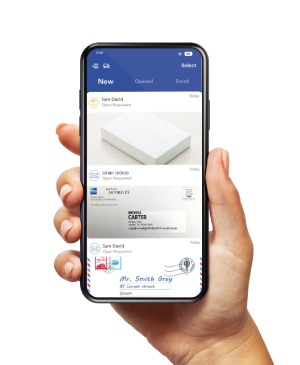
A PostScan Mail virtual mailbox lets you receive mail and manage available handling requests online.
Depending on the selected service and location, you can request content scans or forwarding of physical items.
If your bank permits a separate CMRA mailing address, confirm which correspondence it can send there.
Bank permission for statements does not necessarily cover cards, verification letters, or other restricted deliveries.
Keep the required residence and business-location information accurate in the bank’s records.
Choose a mailbox for mail handling. Review the USPS Form 1583 process to authorize mail receipt through an agent, along with the available services for expats and international users.
Confirm eligibility before choosing an address service
Start with the bank’s requirements for your actual situation. Confirm the account type, address proof, tax information, and whether you need to visit.
Then decide whether you need a separate correspondence address.
PostScan Mail can help you manage physical mail while abroad.
Select that service after confirming the permitted use of the address with the institution that will send the mail.
Access & Manage Your Postal Mail
Anywhere Anytime!
Receive mail anywhere, on any device.
We offer 1000+ mailing addresses for both personal and business use.