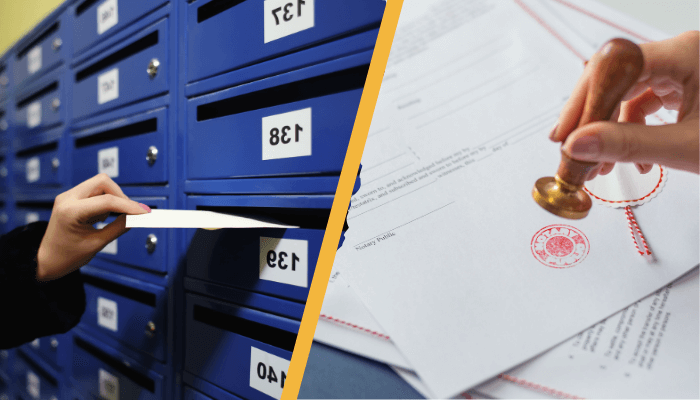
Mail forwarding for digital nomads lets you receive correspondence at one mailing address and ship selected originals to a destination you confirm. A virtual mailbox adds online envelope viewing and content scanning, so you can read many letters without shipping them to every stop.
The service works best when you separate reading mail from receiving originals. Review arrivals online, scan what you need to read, and forward physical items when your destination and stay dates allow for delivery. For a short trip with little mail, help from a trusted contact may be enough.
This guide covers US receiving addresses for travel within the US and abroad.
Table of Contents
How mail forwarding works while you travel
A private mail forwarding provider receives authorized letters and packages at your selected address. You decide which items to send onward and where they should go. A virtual mailbox combines that receiving service with an online account where you can review incoming items and request action.
An envelope image shows the outside of a letter. An open-and-scan request gives you the enclosed document. Physical forwarding sends the original through a carrier. These are separate services, with separate processing steps and possible charges.
Your receiving address can stay the same while you change the destination of future shipments. That does not change the destination of a parcel already in transit. Online account access also does not mean staff process scans or shipping requests around the clock.
Choose between USPS forwarding and a virtual mailbox
USPS forwarding may suit an eligible move or temporary stay at one destination. A private service can suit repeated travel when you want to inspect arrivals and choose what to ship.
| Option | When it may fit | What to arrange |
|---|---|---|
| A trusted friend or relative | Little mail and occasional help | Permission, storage, privacy expectations, and how they will send originals |
| USPS forwarding | A move or eligible stay with a known destination | Identity verification, the correct move type, and direct updates to senders |
| A virtual mailbox with forwarding | Repeated travel and a need to read or sort mail remotely | Mail authorization, scan requests, storage decisions, and shipment destinations |
USPS temporary forwarding initially covers 15 to 185 days and can extend to 364 days with a second request. A private mailbox subscription follows its provider’s terms, not this USPS temporary forwarding period.
Use the official USPS forwarding guidance for the postal process. Allow at least 7 to 10 business days after approval for the change to take effect. Update senders directly because forwarding does not update their accounts, and sender instructions can prevent some mail from forwarding.
Set up your receiving address before you leave
1. Check the location and the mail you expect
List the letters, packages, and originals you expect during your trip. Ask the receiving location about acceptance, scan turnaround, shipping carriers, package limits, and pickup if you plan to return there. Verify signature-required items separately.
Confirm the address format, including the assigned private mailbox number. Check whether each organization accepts it for the intended mailing use. Keep residence, business location, and correspondence fields separate where the organization requires them. Resolve residence and tax questions through the relevant agency or adviser for your circumstances.
2. Complete mail authorization and identity verification
For a US Commercial Mail Receiving Agency, complete USPS Form 1583 and the required verification process. The form requires photo and address identification from the accepted categories. Follow the current signature instructions and your provider’s process.
Form 1583 authorizes the agency to receive mail. It does not redirect mail from your old address. Activate the mailbox before sending correspondence there.
3. Update senders and test the service
Give the address to senders whose correspondence you want to receive there. Arrange USPS forwarding where eligible to catch mail still addressed to your former location. Use a change-of-address checklist to track account updates separately.
Send a test letter before departure. Check that it appears in your account, request a content scan, and confirm how to get the original. Test the tasks you will depend on while traveling rather than assuming that registration completes them.
4. Prepare account access for travel
Enable two-factor authentication where available and confirm you can use the verification method abroad. Keep account recovery information accessible. Use a password you do not reuse elsewhere.
Review the provider’s access, retention, and disposal practices. PostScan Mail publishes its security and privacy controls, including encryption and account controls. Check how the selected facility handles originals and how the platform handles scans.
Decide whether to scan, store, or forward each item
Start with the action the document requires. Reading a notice online may be sufficient, while receiving a replacement card requires the physical item. Confirm original-document requirements with the sender or institution.
| Item or situation | Action to consider | Check before deciding |
|---|---|---|
| A letter you need to read | Request a content scan | Pages, scan charges, processing time, and any response deadline |
| An original you need later | Store it temporarily | Free storage window, daily fees, and your next receiving opportunity |
| A physical item you need soon | Request forwarding | Carrier eligibility, destination acceptance, cost, and arrival window |
| Unwanted correspondence | Request available disposal | Whether you need to retain a record or original first |
Choose a review schedule based on what you expect. A weekly review may fit routine mail, but check more often when waiting for a deadline-sensitive notice. Record the response deadline after reading the document. A notification or scan does not complete the required response.
Confirm your next destination before shipping originals
Ask the hotel, host, coworking space, or other recipient whether it will accept the shipment. Confirm the booking name, full address, arrival and departure dates, local phone number, receiving hours, signature arrangements, and any holding fee.
Build your delivery window around the provider’s handling time, the carrier’s transit estimate, and time for clearance or pickup. A carrier estimate starts with its shipping process, not when you request forwarding. Leave room for delays rather than treating your departure date as a delivery deadline.
For example, if you have four days left at a hotel and a quoted transit range of three to five business days, that range alone does not support shipping there. Ask about another destination where you will stay longer, or keep the original in storage if you can wait to use it. This is a planning example, not a delivery forecast.
In PostScan Mail, select the items, choose Forward, select the destination and available carrier, and review the request before submitting it. The forwarding request instructions explain the process. Recheck saved destinations each time you move.
Compare the full cost of forwarding
Your cost includes the subscription plus any scans, handling, carrier postage, storage, extra recipients, and other services you use. International shipments may also incur destination duties, taxes, or clearance charges. Compare a month with no shipments against a month when you need originals.
PostScan Mail’s published plans and fees list forwarding handling at $2 for the first item and $0.50 for each additional item in a consolidated shipment, plus shipping. Using those fees, four eligible letters sent together produce $3.50 in handling. Four separate one-item shipments produce $8 in handling.
That is a $4.50 handling difference before postage. It excludes the subscription, scans, storage, and all other charges. Combining items does not guarantee the lowest total cost. Weight, dimensions, timing, and shipment eligibility still matter. Check the selected location’s current terms before requesting service.
Compare quoted shipping services for the actual destination and contents. Ask what the quote includes, what remains payable on arrival, and whether tracking or insurance meets your needs. Waiting to consolidate can also add storage charges or delay an original you need.
Prepare international shipments for customs
Check the contents and destination before authorizing an international shipment. Document-only mailings and packages containing goods have different customs requirements. Follow the carrier’s rules for the service you choose.
For USPS shipments, the customs form guidance explains the requirements and document exceptions. Packages require detailed item descriptions. Provide accurate descriptions and values, and don’t label purchased goods as gifts to avoid charges.
Confirm who will provide the declaration information and who will pay any destination charges. Check the receiving country’s current import rules. Mailbox access from another country does not mean every item can ship there or that customs clearance will finish before you leave.
Choose a service around your travel pattern
Choose a service that fits how you read correspondence and how often you need originals. Compare the selected location’s handling times, supported destinations, storage charges, receiving names, and support availability during your working hours. Ask for an example quote for the shipment you expect to make.
PostScan Mail’s mailbox options for travelers and digital nomads combine receiving, online review, and requested forwarding. Choose an address, complete authorization, and test the workflow before relying on it while traveling. Keep future shipments tied to a confirmed destination.