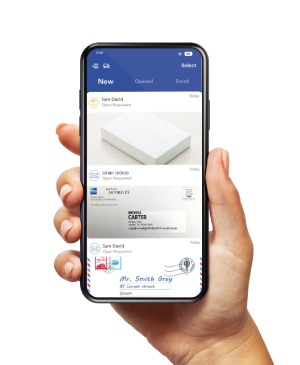
A virtual address for your home business gives customers and suppliers a separate place to send mail while you keep working from home. With a virtual mailbox service, you can also review envelope images, request scans of the contents, and arrange forwarding online. The main benefits are less exposure of your home address and a more manageable flow of business correspondence.
The value depends on what you need the address to do. A mailing service can solve a mail problem; using it for banking, business filings, or a public listing requires a separate eligibility check. Here is how to weigh the benefits before choosing a location and plan.
This guide covers US home businesses.
Table of Contents
What is a virtual address for a home business?
A virtual business address is an address you subscribe to for agreed business use, usually to receive correspondence at a staffed mail location. Your business continues operating from your home or another location.
The address and the tools are related but distinct. A virtual mailbox lets you manage physical mail online. A virtual office package may add workspace or telephone services, depending on the agreement. Do not assume a mailing subscription includes a desk, meeting room, receptionist, or permission to meet customers there.
With PostScan Mail, you can view received items through an online account and request handling such as scanning or forwarding. Confirm availability and terms at your selected location before routing mail there.
Six practical benefits of a virtual business address
1. Share business contact details with less exposure of your home
A separate mailing address helps you avoid putting your residence on everyday customer materials. That matters when proposals circulate beyond the original recipient or an invoice ends up in another company’s records.
Review the places where you control the address: your website contact page, proposals, invoices, stationery, and supplier correspondence. Where appropriate, label the replacement as your business mailing address so people understand its purpose.
This is a privacy boundary, not anonymity. The service does not erase historical records or remove disclosure obligations. Your provider and other organizations may still need your actual residential or operating address.
2. Give customers a consistent place to send correspondence
A dedicated address makes it clearer where business mail belongs. You can use the same approved business name and mailing details across customer documents, reducing confusion between a personal address and a business contact address.
Professional presentation comes from accurate information and reliable communication. Working from home doesn’t make a business less credible, and an address alone doesn’t prove trustworthiness or drive sales.
If customers should not visit the mail location, say so. A clear “Mailing address only” label is more useful than suggesting you maintain an office there.
3. Turn business mail into an organized review routine
A virtual mailbox creates a separate place to review business correspondence instead of sorting it from household mail. With mail content scanning, you can request a digital copy of a letter and decide what needs action without first collecting the original.
An envelope image shows the outside of an item. Reading the enclosed document requires content scanning. Both depend on physical receipt and processing; online account access does not mean staff handle requests around the clock.
For example, a home-based consultant could review a scanned supplier notice while traveling, record its deadline, and request the original only if needed. This is an illustrative workflow, not a promise about processing speed.
4. Receive approved deliveries away from your doorstep
Routing eligible business packages to a mail location can reduce the number left outside your home and the need to wait for a delivery there. It can also separate supplier samples and business correspondence from household deliveries.
Check the actual facility’s carrier support, package size limits, signature handling, storage charges, and pickup hours. PostScan Mail’s service terms qualify acceptance of restricted and signature-required items and require advance confirmation for perishable or temperature-sensitive deliveries.
If you sell products, confirm whether the location accepts customer returns before publishing it as a return address. Receiving a parcel does not by itself include checking its condition, recording inventory, or issuing a refund.
5 Keep a mailing address through a home move
If you move house while keeping the same supported mail location and subscription, you can retain the mailing address already shared with customers and suppliers. Update the destination for forwarded items when necessary.
This can reduce customer-facing changes during a move. It does not eliminate updates to records that require your actual residence or operating location. Keep your provider’s identity records current and review government, bank, insurance, and licensing requirements separately.
Continuity also depends on the provider. Ask what happens if the selected location relocates or closes, and how much notice you would receive.
6. Buy mail handling without renting workspace you do not need
When your home already meets your workspace needs, a mailing subscription lets you pay for address and mail services without taking on a separate office lease. This is useful if receiving correspondence is the only reason you considered commercial space.
Compare it with your real alternative. If home delivery already works well and you do not need a separate address, a virtual mailbox adds an expense. It does not automatically reduce payroll, equipment costs, or the cost of running your home office.
Use the selected location’s plan allowances and additional fees to estimate a normal month and a busy month. Include incoming items, content scans and pages, approved recipient names, forwarding handling, postage, storage, and any pickup charges. Compare annual upfront payments with monthly billing rather than treating the advertised monthly equivalent as the amount due today.
Decide which problem the service needs to solve
The strongest reason to subscribe is a recurring need you can identify.
Use this table to connect a benefit with the evidence to request.
| Your home business need | Potential benefit | Check before subscribing |
|---|---|---|
| You want fewer customer documents to show your residence | Separate mailing details | Which uses permit the address and where your home address will still be required |
| You travel while business letters keep arriving | Remote review through scans | Receipt and scan turnaround, request fees, and original retention |
| You receive supplier parcels while away | Delivery handling at another location | Item acceptance, pickup access, storage limits, and forwarding costs |
| You expect to move house | Continuity of customer mailing details | Provider relocation terms and updates required for physical addresses |
| You only need occasional mail handling | A limited service instead of unused office space | The full cost against keeping home delivery or using another mailbox option |
If you need daily access to original documents, frequent in-person meetings, or substantial inventory storage, evaluate those requirements separately. A basic virtual mailbox may not meet those needs.
Understand where a mailing address is accepted
An address can receive a letter without qualifying for every business purpose. Check the specific form, agency, platform, or institution before paying for a long subscription.
A virtual mailing location does not become your operating premises simply because it has a street address. State filings may distinguish a principal office, mailing address, and registered agent. Banks apply their own verification procedures. A mail service also does not satisfy requirements for activities you perform at home, such as local zoning or lease restrictions.
For local search, Google’s Business Profile guidelines state that a rented mailing address where your business does not operate is ineligible for a profile. Coworking offices have additional conditions, including signage, customer access, and your staff being present during business hours. Buying an address does not guarantee a Google Maps listing or better rankings.
Set up a routine that makes the benefits useful
Choose a service based on the mail you receive, then test it before making a broad change.
- List your intended uses.
Separate customer correspondence from bank verification, government filings, and any return address you need. - Compare suitable PostScan Mail locations.
Check the operator, available handling services, support process, and full costs for your expected volume. - Complete authorization before redirecting mail.
US commercial mail receiving agencies use USPS Form 1583. Follow the current form and provider process for acceptable photo and address identification and signature verification. - Confirm the exact business name and address format.
Preserve the required private mailbox designation, then send a test letter and check receipt, scanning, and download quality. - Update selected senders and documents.
Review any postal forwarding request carefully so it matches the business mail you intend to redirect. A mail change does not automatically update government or financial records. - Assign a regular review time.
Record deadlines outside the mailbox, download important scans, and choose whether to retain, forward, or securely dispose of each original.
Use a unique password and enable available account protections. Review the provider’s published security controls, access permissions, retention terms, and closure process before sending sensitive correspondence.
For a simple starting routine, use the following handling rules. Adjust them to the documents your business actually receives.
| Mail type | Suggested action | Before disposing of the original |
|---|---|---|
| Supplier invoice | Request a scan and record the payment deadline | Confirm your recordkeeping requirements and download the complete document |
| Signed agreement | Review the scan and decide whether to request forwarding | Confirm whether you need the original signatures or physical document |
| Customer return or product sample | Verify the item is accepted and arrange approved handling | Confirm where it must go next and when storage fees begin |
| Unwanted solicitation | Review the sender and select an available disposal option | Check that it is not a renewal notice or other actionable correspondence |
Choose an address that fits how you work
A virtual address can be worthwhile when it creates a clearer boundary around your home, keeps business mail organized, or lets you review correspondence while away. Its usefulness comes from matching the location and handling plan to your actual work.
Explore PostScan Mail’s virtual business address service, then confirm the chosen address supports your intended uses. Start with a realistic mail-volume estimate and a test delivery before updating your customer materials.
Access & Manage Your Postal Mail
Anywhere Anytime!
Receive mail anywhere, on any device.
We offer 1000+ mailing addresses for both personal and business use.